


Blog
Is Your Himalayan Salt Lamp Real? Here’s How to Spot a Fake.

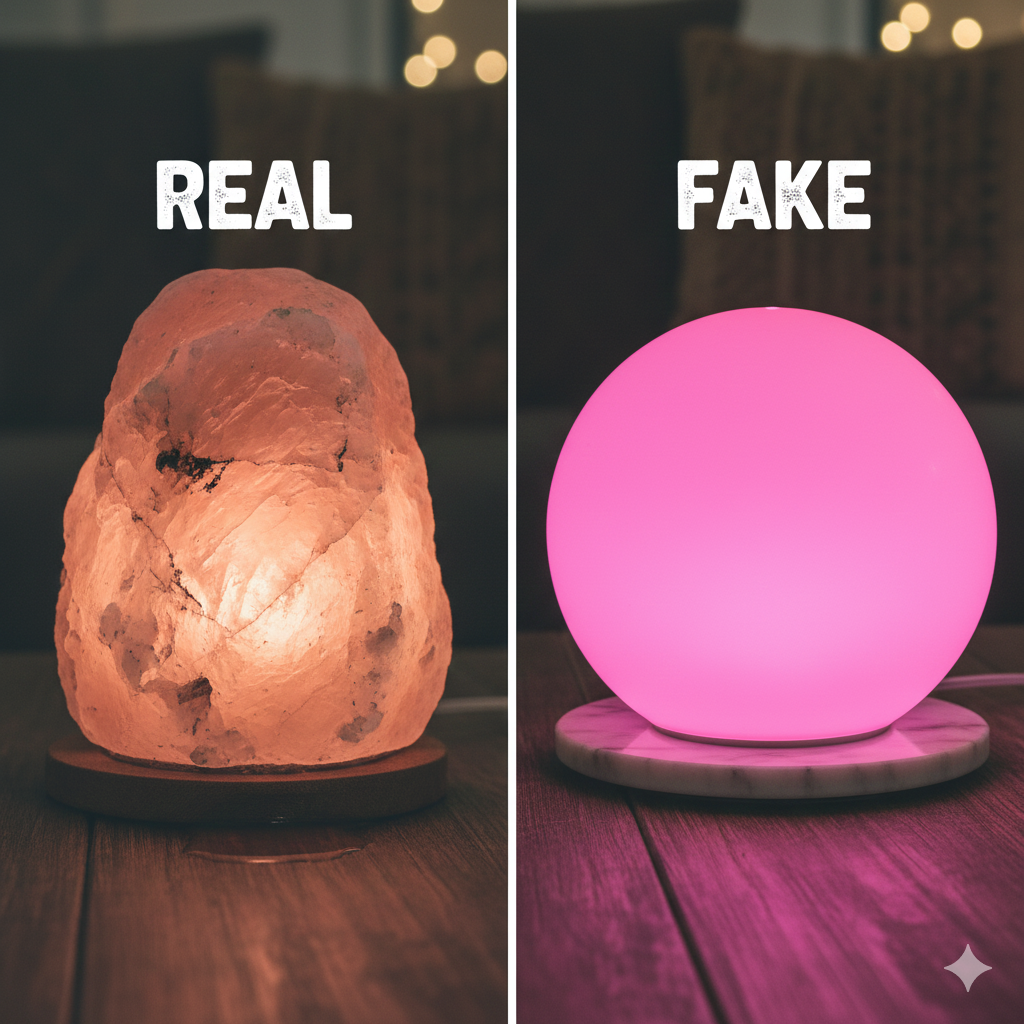
You finally bought one. It’s sitting on your table, glowing away. But a nagging doubt creeps in. Did you get the real deal or just a hunk of orange plastic? It’s a fair question since fakes are definitely out there in the market. Let’s figure it out together real quick.
The “Too Perfect” Problem
Real nature is messy. It doesn’t make perfect things.
If your lamp looks like a perfectly smooth, uniform block of bright orange, be suspicious. Real Himalayan salt crystals have cracks, weird veins, and dark spots inside them. They have character and look rugged.
If it looks exactly like the picture on the box, it might be mass-produced fake material.
Multimedia Suggestion: This is the perfect spot for a side-by-side image comparison. On the left, show a rugged, imperfect real lamp with visible cracks. On the right, show a super-smooth, perfectly uniform fake one. Label them “REAL” and “LIKELY FAKE”.
The Ultimate Test: Does It Sweat?
The most reliable way to know if your salt lamp is real is checking if it reacts to humidity. Real salt is hygroscopic, meaning it naturally attracts water from the air. In humid Pakistani weather, if the lamp is turned off for a day or two, it should start dripping water or feel very damp. A fake plastic or glass lamp will stay completely dry no matter how humid it gets outside.
The Monsoon Reality Check
Living in Pakistan actually gives us an advantage for this test. Our humidity is usually high, especially during monsoon season.
If you leave a real lamp turned off for a few days in July, it’s going to make a salty puddle on your table. It’s annoying, sure, and you need a coaster. But that mess is proof that it’s authentic salt doing its thing.
The Light Test
Real salt rock is dense and heavy. It doesn’t let light pass through it easily.
It Should Be Dim
When you turn it on, the glow should be muted, soft, and uneven because of the internal cracks. You shouldn’t be able to read a book clearly by its light.
If it lights up the whole room brightly like a standard 60-watt bulb, you’re likely looking at colored glass or plastic that lets too much light through.
Why Does It Matter Anyway?
You might ask, who cares as long as it looks nice? It matters because you paid for salt from Khewra, right here in Pakistan.
Data Suggestion: Insert a small text box here with a quick fact to establish origin authority: “Fact: True ‘Himalayan’ pink salt is mined in the Punjab region of Pakistan, mostly around the Khewra Salt Mine. Salt from other regions is not the same.”
Fake lamps are just decor. They are usually lighter than real salt and just don’t feel right. They won’t give you that authentic, earthy feel of having a piece of local geology in your room.
Conclusion
Don’t overthink it too much. Just look for imperfections like cracks and dark spots. More importantly, watch how it handles our humid weather. If it sweats when it’s off and has a soft, uneven glow when it’s on, you’ve likely got the real thing. Enjoy that natural vibe.
