


Blog
Pink Himalayan Salt vs Table Salt: Health Comparison

Pink Himalayan Salt vs Table Salt: Health Comparison
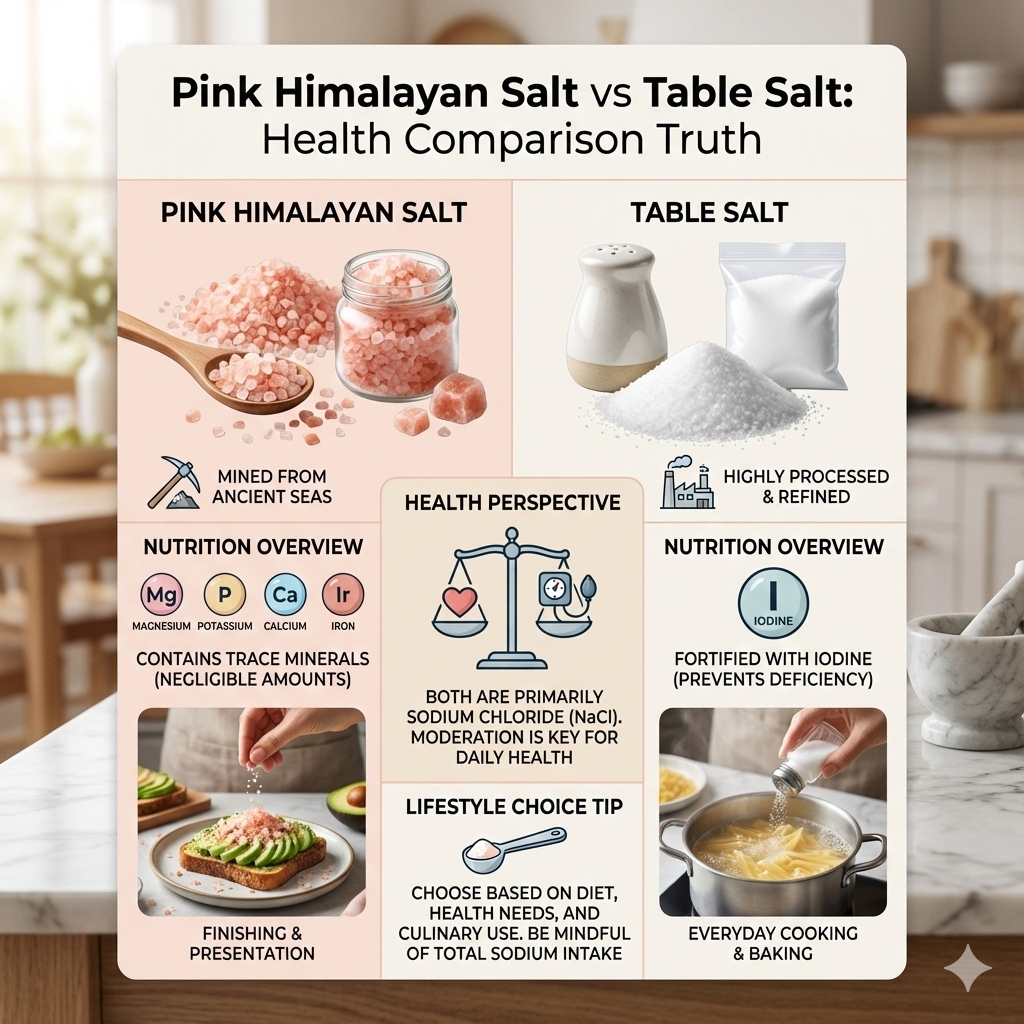
The pink Himalayan salt vs table salt is the frequent question of individuals who want to make dietary choices.They are both types of sodium chloride although there are differences in the source, processing and nutrition profile.The salt product is the Pink Himalayan salt, which is found at the Khewra salt mine in Pakistan and whose natural trace minerals are known.Table salt is very fined and normally supplemented with iodine to promote the health of the thyroid.Here is the comparison between these foods in terms of health outcomes, mineral content, daily use, and safety, thus you can know which salt will suit your diet, cooking and long-term health requirements.
What Is Pink Himalayan Salt?
Pink Himalayan salt is an undulented rock salt that is primarily obtained by the extraction of the Khewra salt mine located in Pakistan which is one of the oldest and largest salt mines in the world. It was developed millions of years ago in the evaporation of the old ocean beds that enabled the trace minerals such as calcium, magnesium, and potassium to be incorporated into its crystal structure. Pink Himalayan salt is not refined and is only a little aromatized; as a result, it is able to preserve its natural texture and color. It is a pure form that explains why it is commonly utilized in cooking, health and beauty products as well as decorative objects like salt lamps and bath salts.
What Is Table Salt?
Table salt is a highly refined sodium chloride that is industrially manufactured. Refining process involves eliminating natural minerals in an effort to come up with a homogenous, fined-grain salt that has a uniform taste. Procedures are followed after purification to include iodine by way of iodization to assist in the preventive actions of lack of iodine, which is conducive to normal thyroid functioning. To prevent clumping and extend shelf life, anti-caking agents are also added in. Due to this high refining process, table salt appears white and dissolves easily, however, it is no longer in its form of trace minerals in natural salts. Typical applications are typical cooking and packaged foods, as its cost is low, and it is widely available.
Nutritional Comparison (Side-by-Side)
Comparing the pink Himalayan salt and table salt, there is not much difference in the sodium content considering that both are composed primarily of sodium chloride. The variation is reflected in trace minerals. Occasionally it is formed by small quantities of minerals such as potassium, calcium and magnesium in Pink Himalayan salt and this is what makes it light pink in color. However, during the refining process, all these minerals are extracted in table salt; however, iodine is added intentionally to it. Iodine is beneficial to have in thyroid, and trace minerals in Himalayan salt occur in insignificant quantities and cannot be regarded as a significant source of nutrients. The body absorbs sodium in an equal manner in both salts.
Health Benefits — What’s Real and What’s Not
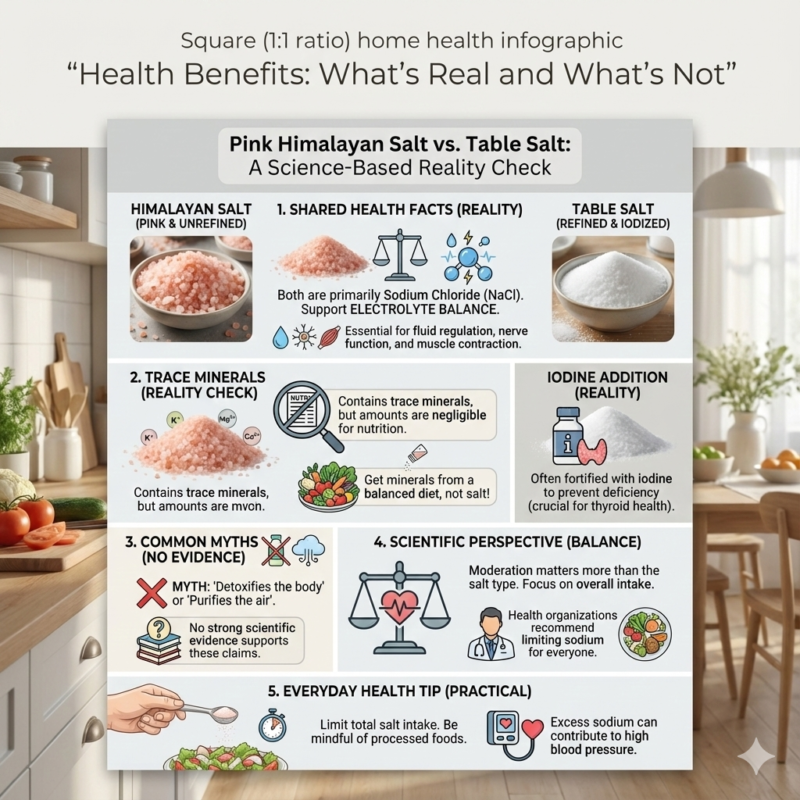
The controversies about pink Himalayan salt and table salt will always centre on whether it is healthy or not, but one should be able to differentiate between myths and facts. The two types of salts facilitate the normal electrolyte balance since sodium aids in the regulation of fluids, nerve impulses and muscle activity. The pink Himalayan salt has trace minerals but in insignificant amounts. The argument of purifying the body or remedying conditions does not have significant scientific proofs. Scientifically moderation is of more importance than the type of salt. Overdose of any salt may impact blood pressure whereas a conscious use aids in daily health requirements.
Iodine, Thyroid Health & Who Should Be Careful
Iodine is also important in thyroid health as it is believed to facilitate hormone synthesis which indicates the metabolism and growth. The principal difference between pink Himalayan salt and table salt is iodine. The Himalayan salt is unrefined and may not have added iodine whereas the table salt may be iodized to aid against deficiency. Iodine requirements are greater in children, pregnant women, and the older population, and thus consumption of iodized salt should be avoided because it may pose a greater risk in the long term. Iodized salt is an important aspect in areas where intake of iodine is low. The selection of the appropriate salt should be based on the balance of the diet and not on trends.
Impact on Blood Pressure & Heart Health
In the case of pink Himalayan salt and table salt, it should be known that both are still sodium salts. Regardless of the type of salt consumed, sodium in excess will bump up blood pressure and add pressure on the heart. Himalayan salt also has trace minerals but these minerals do not negate the effects of excess sodium intake. To maintain good health in the heart, the amount of salt consumed is more important than its type. Majority of health systems recommend that one should minimize daily sodium amounts and supplement it with foods rich in potassium. Considering that you are at risk of high blood pressure, kidney problems, or heart conditions, it is advised to take the medical recommendations into account and do not substitute prescribed recommendations with the dietary trends.
Taste, Cooking & Everyday Use
Pink Himalayan salt has a small but slightly mineral taste compared to the clean and sharp taste of table salt. It has a crass crystal texture, so it is ideal to splash on the dishes or to season grilled meats, while finer salt in the Himalayas can be used in cooking and baking activities. Table salt is dissolves easily, has equal size/grain, and includes anti-caking added, which is suitable to baked products and sauces. You can select the correct salt in each recipe but knowledge of texture and consistency can assist you to select the correct salt in each recipe. Most chefs and domestic cooks like Himalayan salt because of its aesthetic look and taste, also it can replace the table salt in most recipes.
Which Salt Is Better for You?
It is up to you to use pink Himalayan or table salt, as it depends on your lifestyle, diet and health status. Depending on their use, either salt may be used in the cooking; however, Himalayan salt might have trace minerals and taste, which some of them like. People with deficit of iodine should have adequate intake then they importance of iodized table salts. Patients with high blood pressure or cardiovascular issues should pay attention to the total sodium intake, irrespective of the type. Balance and portion control are more important than salt variety, which are used in practical application. An additive addition of Himalayan salt may provide a visuality and a delicious touch, yet it can be regarded as a friendly approach to a diet.
Common Myths About Pink Himalayan Salt
There is a lot of confusion that surrounds pink Himalayan salt and this is what humiliates consumers. Such statements as, it contains 84 minerals are technically accurate in the small amounts, but it is unlikely that they will have important health consequences. The scientific literature bases on the detox or cleansing benefits of Himalayan salt baths or consumption, have little backing by scientific research. Likewise, claims of weight loss associated with its use are not accurate because no type of salt by itself would burn fat or make one lose weight. Although Himalayan salt has flavor, aesthetic appeal and some trace minerals, it is to be used in moderation as a substitute one would give normal salt, as a component of a balanced diet and not expecting it to work wonders with regard to health.
Conclusion
Each type of salt, Pink Himalayan and table salt has its peculiarities, but knowing the difference enables you to make right health, cooking, and wellness choices. Although pink salt has some trace minerals and is aesthetically pleasing, Iodized table salt is necessary to prevent deficiency. The two should be added in moderation into your food depending on the lifestyle, health status, and cooking requirements. To learn more, see our specific product range to compare grades of pink Himalayan salt, sample it to check quality or get our wellness selections delivered to your door. Begin improving your health and food with the appropriate salt today.
FAQ (Schema-Ready)
Is pink Himalayan salt healthier? Pink salt offers trace minerals, but nutritionally it’s similar to regular table salt; its health impact is modest.
Can it replace iodized salt? While you can use it for flavor, it does not provide sufficient iodine, so iodized salt remains important for thyroid health.
How much salt per day? Adults should aim for 5–6 grams daily (about 1 teaspoon), balancing all dietary sources to maintain healthy sodium levels.
Is pink salt safe for kids? Yes, in moderation, but ensure iodine intake through iodized sources to support growth and development.
